White paper, published in the corporate client area of WIFI (update of the 2024 edition).
By 2025, artificial intelligence has rapidly woven itself into society, the world of work and people’s private lives, and it continues to gather pace. This white paper updates and extends the 2024 version. It gives HR leaders, and everyone concerned with the world of work, a fresh overview of how AI is being used in people management across Europe, the opportunities and real challenges it brings, and the ethical and legal aspects that are now coming firmly into focus.
Geoffrey Hinton is known as the “Godfather of AI”. He played a key role in the development of “artificial intelligence”. Since leaving Google, he has been explaining to the public what AI is capable of and how much we still underestimate it. AI is built on mathematics. Large language models predict the next syllable or word – a task that seems simple but is in fact complex. In Hinton’s view, however, machines’ ability to do this is underestimated; in theory, they could even develop further on their own if they keep learning. Given the rapid development of AI and its impact on the world of work, Hinton recommends taking up a skilled trade such as plumbing. In his opinion, a great many entry-level and mid-level jobs will be replaced, while new jobs emerge.
People management and its challenges
McKinsey HR Monitor 2025
Since the end of 2022, we have seen rapid progress and growing interest in artificial intelligence. Many studies reflect these developments. The new McKinsey HR Monitor 2025 shows that HR departments in Europe face a twofold challenge: on the one hand, they need to raise the strategic importance of workforce planning, talent development and employee experience; on the other, they need to scale up the use of generative AI and modern HR operating models significantly. Only by integrating these areas can HR mature from an administrative service provider into a true strategic partner.
Although 73 % of companies in Europe carry out operational workforce planning, a strategic three-to-five-year perspective is often missing. At the same time, according to HR leaders, 32 % of employees show gaps in their current roles – particularly in problem-solving, data analysis and AI know-how. Skills-based workforce planning, supported by AI-driven scenarios, is therefore becoming a key prerequisite for competitiveness.
The success rate for completed employment contracts in Europe currently stands at just 46 %. The main causes are low offer acceptance rates (56 %) and high dropout rates during the probationary period (18 %). To counter this, so-called talent win rooms are recommended, which steer recruiting processes in a data-driven, cross-functional way, alongside more consistent use of internal mobility. Talent win rooms are specialised teams within a company that use data-driven methods and cross-departmental collaboration to optimise the recruitment and development of talent. They draw on modern technologies such as artificial intelligence to make people processes more efficient and more targeted. Generative AI in particular can deliver substantial efficiency gains in screening and in creating job profiles. While HR often regards pay and benefits as the most important retention factors, employees cite job security, work-life balance and relationships with colleagues as their main reasons for staying. This gap carries the risk of quiet quitting. Future-ready HR must therefore rely more heavily on individualised, data-driven employee experience strategies.
Gen AI and self-service platforms make HR processes considerably more efficient: high-performing organisations raise their HR-to-employee ratio from 1:70 to 1:200 employees per HR FTE. Yet in Europe only 19 % of core processes are currently supported by AI. Those who invest now in governance, pilot projects and scalable AI strategies can develop HR into an even more effective, people-centred and future-ready partner.
The current state of people management
A further study by Gartner on people management and artificial intelligence systems reveals, alongside the challenges already mentioned, the first signs of upheaval in organisations. Specifically, Gartner surveyed the integration of artificial intelligence into the HR function and gathered some compelling data.
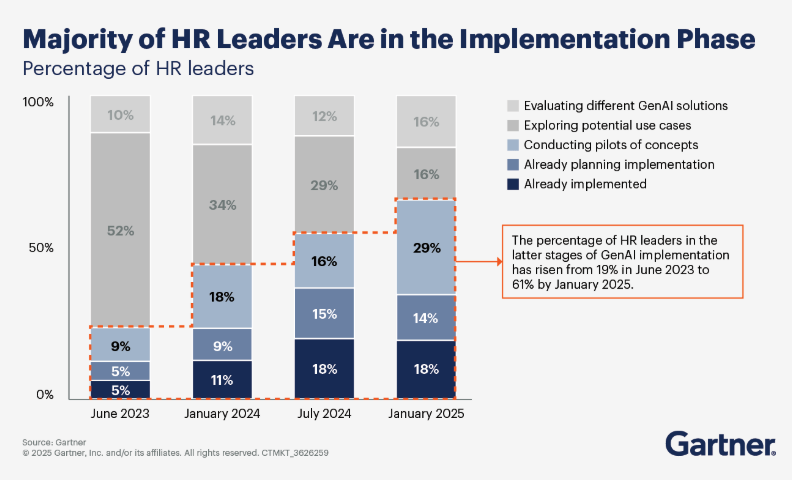
Figure 2 shows how rapidly the share of AI applications in HR has grown within just a few years, underlining the pressure on companies to prepare deliberately for technological transformation. The dynamic spread of generative artificial intelligence (GenAI) within the HR function – reflected in a rise from 19 % in 2023 to 61 % in early 2025 – calls for a strategically grounded realignment of the HR operating model. HR leaders need to introduce new roles such as AI product owners, GenAI experts and heads of innovation, and establish an AI Centre of Excellence that coordinates pilot projects, builds capabilities and secures strategic value. At the same time, it is foreseeable that around 37 % of the workforce will be affected by generative AI within the next two to five years. We are unlikely to see a net reduction in jobs by 2026, but AI will play a significant role in creating new, agile forms of work by 2036. The key to sustainable implementation is a human-centred approach: HR must act as an ethical authority, promote transparency and shape change management so that AI implementations both create value and build trust.
Use in HR in Austria
But after all these figures and recommendations, what does the use of AI in people management look like in Austria?
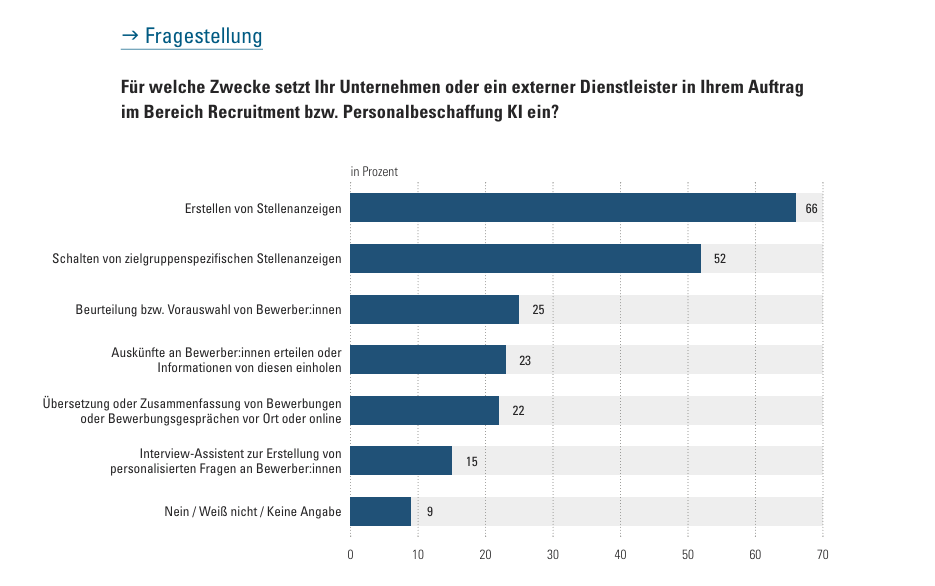
In a representative company survey, the AI Service Desk of the Austrian regulatory authority for broadcasting and telecommunications (Rundfunk und Telekom Regulierungs-GmbH, RTR) analysed the current use of AI technologies in people management. The aim was to build a sound picture of how companies use AI-based systems to optimise HR processes while preparing for the requirements of the EU AI Act.
The report shows that AI is used above all for the automated pre-selection of applicants and to make internal HR processes more efficient. Applications range from algorithm-based matching and CV analysis to supporting training and employee retention.
Even before most of the AI Act’s obligations come into force, many companies are already putting accompanying measures in place. These include documenting AI-supported decisions, introducing transparency policies towards applicants, and first steps towards risk assessment and system classification.
At the same time, companies identify key challenges in using AI in HR. These include legal uncertainty about how exactly to implement the new regulations, technological hurdles in integrating secure and compliant AI solutions, and acceptance issues among employees and applicants.
Given that the AI Act classifies many HR-related AI applications as high-risk, engaging early with regulatory requirements is becoming increasingly important. Companies must ensure transparency, explainability and non-discrimination, and establish appropriate control mechanisms. More on this in section 3.
General use and openness in Austria
So what does AI use look like in Austria more broadly? Around a quarter of the Austrian population rate their knowledge of artificial intelligence as good, while 73 % report little or no knowledge (Statistik Austria, 2025). Only 35 % view the growing use of AI in society positively, compared with 50 % of 16- to 24-year-olds – and 57 % of this age group have used generative AI tools such as ChatGPT in the last three months. University graduates are also more open: 50 % view the use of AI positively and 52 % have used generative tools. Overall, 31 % of the population have already used such a tool, but only 4 % do so daily or almost daily. The differences between the sexes are as follows: 39 % of men view the growing use of AI positively, compared with 31 % of women. Interest in learning more about AI remains muted at 32 %, as does its perceived professional relevance – only 43 % of people in work see potential for their day-to-day work, while just 13 % are worried about losing their job to AI.
Taking into account the latest findings from the WIFI Training Barometer 2025: “AI training as the key to Austria’s competitiveness”, education and training remain a key success factor for companies. Half of all companies recognise the value of AI, yet there is still ground to make up. Markus Raml of WIFI Österreich stresses that targeted training and the right framework conditions are crucial to securing innovative strength and future viability, and highlights WIFI’s wide range of services and training programmes (www.wifi.at/ki). The willingness to learn is high, and both companies and employees are very satisfied with the training they have received so far. Nevertheless, there is a gap between aspiration and actual implementation, often due to lack of time or cost. On average, companies cover more than half of training costs, with public funding providing additional support. Flexible learning formats such as blended learning have become established and make lifelong learning easier. Industry representatives are calling for education and training – especially in AI – to be strengthened as a strategic location policy and for state incentives to be expanded further in order to secure Austria’s competitiveness in the long term. The EU has also created the legal framework for this.
The legal framework for using AI in people management
With the EU AI Act entering into force on 1 August 2024, a new regulatory era has begun for the use of artificial intelligence. Strict rules apply in HR in particular, as HR systems fall into the high-risk category when they are used, for example, for recruiting, promotion decisions, performance appraisal or dismissals. The specific obligations are coming into force in stages. The EU has now actively implemented the rules on the use of general-purpose AI models (GPAI): since August 2025, binding rules on transparency, safety and copyright have applied, together with record-keeping and documentation obligations for providers of such models. In addition, guidelines, a Code of Practice and a template for training data summaries have been published to help providers achieve compliance.
Alongside the legal framework, ethics is of central importance when using AI in HR. Companies are responsible for ensuring that AI systems are used not only lawfully but also in a way that is fair, non-discriminatory and people-centred. This includes:
- Transparency and explainability: applicants and employees must be able to understand how decisions are reached.
- Fairness and diversity: AI must not reinforce existing prejudices. Training data and algorithms must be checked regularly for bias.
- Respect for human dignity: decisions about careers must not be fully automated – the “human in the loop” remains essential.
- Data protection and trust: handling personal data with care is an ethical as well as a legal duty.
- Leadership responsibility: HR departments should develop guidelines that clearly define how AI is to be used responsibly, and train employees in its use.
This makes one thing clear: legal requirements and ethical responsibility go hand in hand. Only those who address both levels can use AI in people management sustainably, in a trustworthy way and in the interests of employees. Companies and HR leaders should therefore define ethical guardrails before deploying the technology in their organisation.
Article 4, February 2025: first obligations – AI literacy for users
Since February 2025, companies have been required to ensure that employees who work with AI systems have a sufficient understanding of how they work, and of their opportunities and risks. This so-called AI literacy covers basic knowledge of:
- How AI systems work, in particular data-based decision-making processes and the limits of algorithmic predictions
- Risks and bias, i.e. possible distortions in the results and their impact on applicants and employees
- The rights of those affected, e.g. the right to transparency, information and human review of decisions
- Responsibilities within the company, such as who is responsible for selecting, monitoring and documenting the AI
In concrete terms, this means HR departments need to set up training programmes, above all for themselves and for other managers. Works councils and employee representatives also need access to AI literacy training, such as that offered by WIFI, so that they can exercise their oversight rights effectively. Practical guidance (checklists, guides) should support safe everyday use, for example when screening applicants or using chatbots in onboarding.
The AI literacy obligation is therefore not a “nice to have” but a minimum regulatory requirement with a direct impact on capability building in organisations. It opens up new opportunities for training providers such as WIFI and for in-house HR academies to develop structured programmes that combine technical knowledge with ethical and legal fundamentals.
Implementation obligations for high-risk systems
By August 2026 at the latest, all companies using high-risk AI systems in HR must fully meet the extensive requirements of the EU AI Act. Applications classed as high-risk include, in particular, those in recruiting and selection, promotions, performance appraisal and dismissal decisions.
The obligations include:
- Documentation: complete records of how the systems in use work, their training data and the basis for their decisions
- Risk assessments (AI impact assessments): regular reviews of potential risks with regard to fairness, non-discrimination and fundamental rights
- Human oversight: ensuring that critical decisions are never made purely automatically but can always be reviewed by qualified people
- Transparency towards applicants and employees: an obligation to inform them clearly and comprehensibly when AI systems are used in decision-making, including the option to ask questions or request a human review
For HR, this means that structural adjustments must be completed by 2026: new processes, trained roles (e.g. AI officer, compliance leads), agreed works agreements and control mechanisms integrated across the entire employee life cycle.
Extension to embedded systems
From 2027, the requirements of the EU AI Act will be extended further: embedded systems that use AI functionality indirectly within HR processes will then also fall under the regulation. These include ERP or HCM platforms containing AI modules for performance analytics, matching functions or roster optimisation. The regulation will therefore no longer cover only “classic” HR AI tools (e.g. applicant tracking systems with algorithmic screening) but also integrated software solutions that use AI components in the background.
For HR departments, this means:
- Platforms already in use in 2026 must be checked for embedded AI functionality.
- Companies are responsible for compliant use, even if the AI component comes from the vendor.
- Contracts with software vendors must be adapted: supplier compliance requirements, documentation obligations and audit rights will become mandatory elements.
This step makes clear that AI regulation in HR will not remain isolated but will reach right across standard software environments. Companies would be well advised to keep a comprehensive inventory of all systems today, so as not to be caught out by hidden AI functions in 2027.
AI Welfare & Human Sustainability
The use of artificial intelligence in people management must not be driven solely by efficiency gains and cost savings. The question of how AI can contribute to wellbeing, fairness and sustainable work design is moving ever more to the fore. Under the heading of AI welfare, an international discourse is emerging that looks at the societal and individual impact of AI on the world of work.
Definition and international guidelines
AI welfare covers the impact of AI on the wellbeing of employees, applicants and society. This includes fair access to jobs, protection against discrimination, mental and physical health, and the right to development and upskilling. International organisations such as the OECD, UNESCO and the ILO are already embedding these principles in their guidelines. They call on companies to use AI not only lawfully but also in a people-centred way that promotes wellbeing.
What it means for HR
For HR departments, AI welfare means an extension of their traditional responsibility:
- Fairness in recruiting: ensuring that AI systems treat applicants objectively, regardless of gender, age or background
- Wellbeing in everyday work: avoiding digital stress through transparent processes, appropriate use of monitoring tools and protection of privacy
- Employee development: using AI to enable personalised learning and career paths and to reveal upskilling needs in good time
- Work-life balance: using AI-supported planning tools to optimise working time while taking individual needs into account
The Austrian context
With its social partnership and the co-determination rights of works councils, Austria has a strong foundation for integrating AI welfare into corporate practice. Works agreements under § 96 and § 96a ArbVG (Labour Constitution Act) provide a binding framework for designing AI applications so that they respect employees’ wellbeing and protective rights. Educational institutions such as WIFI can contribute through AI literacy programmes that help employees and managers use AI applications competently, critically and responsibly.
Recommendations for people management
To integrate AI welfare systematically into people management, companies should take several steps. A key step in anchoring AI welfare in HR work is to extend traditional HR metrics with indicators that put wellbeing and fairness centre stage. Alongside established measures such as staff turnover or time to hire, new metrics such as a “Digital Stress Index”, a “Fairness Score” in recruiting or an “Employee Wellbeing Index” are gaining importance. They make the social impact of AI use visible and allow it to be factored systematically into the management of HR processes. It is also crucial to consistently strengthen transparency obligations. Applicants and employees must be informed clearly and comprehensibly about when and how AI systems are used in decision-making. This builds trust, lowers barriers to acceptance and helps ensure that AI is perceived not as a threat but as a supportive tool.
Another central aspect is linking AI literacy with welfare issues. Training programmes should not only explain how AI works and its technical foundations but also address social, ethical and employment law questions. This gives employees a more rounded understanding of opportunities and risks, enabling them to use AI solutions thoughtfully and responsibly.
Involving the works council from the outset is also indispensable. Early consultation with employee representatives helps avoid potential conflicts, increase acceptance of new systems and create a shared basis for fair conditions. As important partners, works councils can help bring the employee perspective in systematically.
Finally, pilot projects should be measured not only against efficiency metrics but also by their impact on satisfaction, fairness and the overall wellbeing of employees. Such a holistic evaluation approach makes it possible to identify opportunities and risks in good time and to develop AI applications further so that they create both economic and social value.
AI welfare makes it clear that the competitiveness of organisations will in future depend not only on efficiency gains but also on their ability to make workplaces fair, healthy and sustainable. AI can be both a risk and an opportunity. What matters is whether HR takes on the role of an ethical authority and integrates welfare criteria into all AI-related decisions. Companies that do so will not only meet regulatory requirements but also position themselves as attractive, responsible employers.
Status quo – AI integration in people management in companies
The use of artificial intelligence in people management has gained noticeable momentum over the past two years. While pilot projects and isolated applications initially dominated, many companies now rely on AI to make recruiting, talent management and administrative processes more efficient. However, studies such as the McKinsey HR Monitor 2025 and the Austrian RTR survey paint a mixed picture: on the one hand, AI systems open up considerable potential for saving time and money, making better-matched decisions and personalising the employee experience more strongly. On the other, legal uncertainty, a lack of expertise and reservations among applicants and employees persist.
A particular challenge lies in data maintenance and data management. AI systems can only be as reliable as the underlying HR data is current, complete and of high quality. Unstructured or incorrect master data leads to distortions, flawed analyses or inaccurate forecasts. It is therefore becoming increasingly essential for companies to introduce consistent data standards, define clear responsibilities for data quality and build continuous data maintenance into HR processes. Only then can AI realise its full potential while building trust among managers and employees alike.
Generative AI tools are increasingly being integrated directly into existing HRM systems. Microsoft Copilot, for example, now supports HR departments and managers in Office 365 environments in creating job advertisements, analyses and presentations, while ChatGPT is increasingly used as a communication and recruiting assistant, for instance to draft job profiles or as a chatbot in the application process. Established HR platforms are also gradually adding AI functionality to their solutions, so that analyses, forecasts and administrative tasks are supported directly within the HR workflow.
The integration of AI into HR is therefore an ongoing transformation process. The decisive factor will be bringing technological benefits into line with regulatory compliance, ethical responsibility, professional data management and cultural acceptance.
Outlook: AI in people management to 2030 and beyond
As early as 2030, more than 60 % of traditional HR tasks could be taken over entirely by AI systems. This marks a paradigm shift: routine work that has so far absorbed much of HR staff’s time will give way to space in which creativity, strategic thinking and meaningful leadership tasks take centre stage.
According to a study by the McKinsey Global Institute, around 30 % of current working hours will be taken over by technologies such as generative AI by 2030, with a potential productivity gain of up to 3 % a year. The restructuring of the labour market will be profound: up to 12 million occupational transitions are forecast – with particular emphasis on the need for rapid reskilling.
The forecast is clear: AI will become the core strategic technology in HR, not only boosting efficiency but finally transforming HR from administrative work into the role of a people-focused strategist. HR will become the central team of architects for capability development, learning organisations and a humane culture for the future.